The Struggle
For Nimo, the language barrier wasn't just inconvenient, it was isolating. In a camp home to over 20 nationalities, English is the common thread that connects communities, opens doors to education, and creates opportunities. But for Nimo, English felt like a fortress she couldn't breach.
"I could read a little, write a little," she explains, her voice steady but reflective. "But speaking? Speaking was terrifying. Every time I tried to say something, I could feel my heart racing. I was afraid people would laugh at my accent, my grammar, my mistakes."
The fear followed her everywhere. At the market, she stayed silent while others negotiated prices. At community meetings, she listened but never contributed. When opportunities for training or education arose, she watched from the sidelines, knowing she had the intelligence and the drive, but lacking the words to prove it.
"As a young woman in the camp, I felt like I had to work twice as hard to be heard," Nimo shares. "But without English, I felt like I had no voice at all. I started to believe that maybe I wasn't meant for bigger things. Maybe I was meant to stay quiet."
The Turning Point
The shift came when Nimo's friend Fatima told her about RAHA's English Training Program. At first, Nimo hesitated. She'd tried to learn English before, through radio programs, borrowed textbooks, watching videos on a friend's phone, but nothing had stuck.
"I thought, 'What makes this different?'" Nimo recalls. "But Fatima told me, 'They don't just teach English. They teach you to believe in yourself.' That's when I decided to try."
From day one, Nimo noticed the difference. The RAHA instructors didn't just focus on grammar and vocabulary, they focused on confidence. They created a space where young women like Nimo could practice speaking without judgment, where mistakes were celebrated as learning opportunities, where every voice mattered.
"They made us stand up and speak in front of the class," Nimo says with a laugh. "At first, I wanted to disappear. But they were so patient. They said, 'Your accent is beautiful. Your story is important. Don't hide it.'"
The Transformation
Over four months, something remarkable happened. Nimo didn't just learn English—she discovered herself.
The program's structure was intensive but supportive: daily conversation practice, weekly presentations, peer mentoring, and real-world application through community projects. Nimo threw herself into every activity, often staying late to practice pronunciation or volunteer for leadership roles in group exercises.
"The breakthrough came during week six," Nimo remembers, her eyes brightening. "We had to give a five-minute speech about our dreams. I stood up, and instead of shaking, I felt... strong. I talked about wanting to become a nurse. I talked about helping women in my community. When I finished, the class gave me a standing ovation. I cried."
That moment unlocked something in Nimo. She realized that her voice—her accented, imperfect, powerful voice, had value. She realized that her story as a Somali refugee young woman wasn't a weakness; it was her strength.
The New Reality
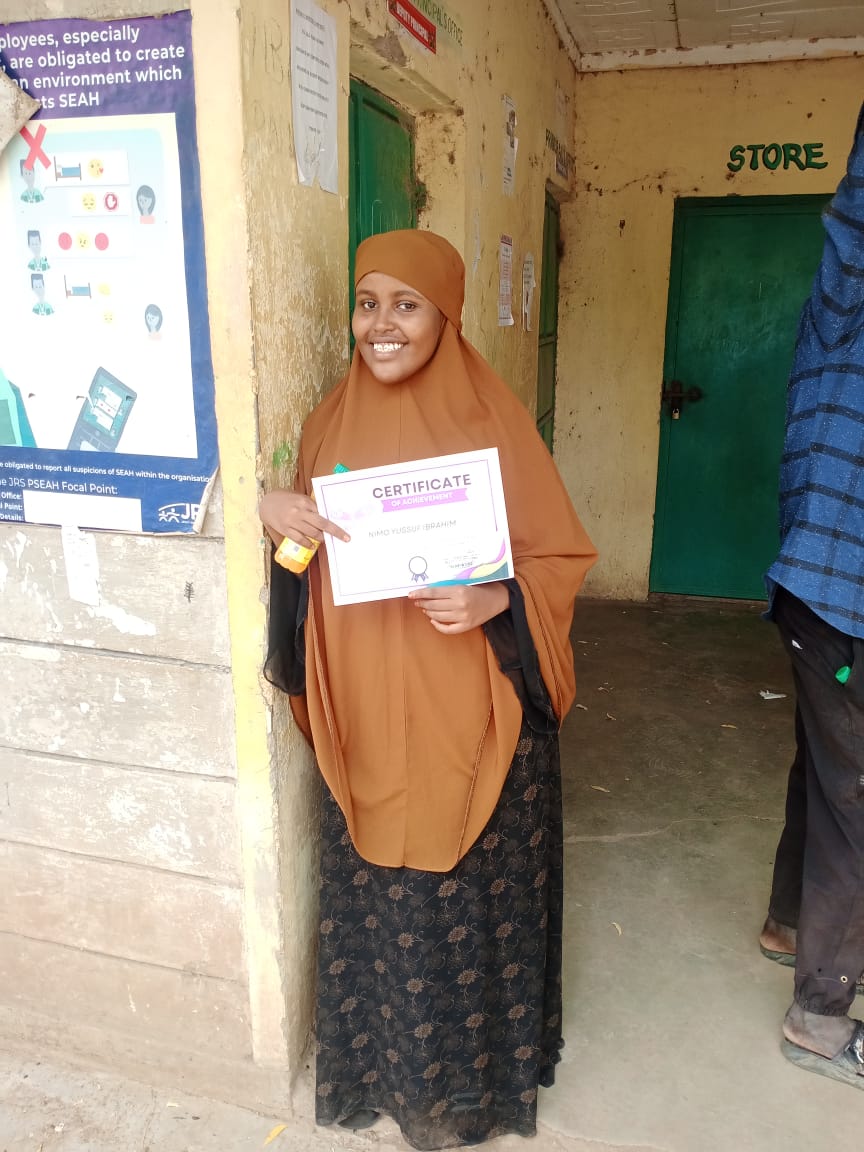
Today, Nimo Abdi is unrecognizable from the quiet, hesitant girl who once sat in the back of the classroom. She's now enrolled in a healthcare training program, preparing for a career that will allow her to serve her community. She volunteers as a peer educator, helping other young women build their English skills. And she's become a vocal advocate for girls' education in the camp.
"I'm not just speaking English now," Nimo says proudly. "I'm speaking up. I'm speaking out. I'm speaking for myself and for other girls who feel invisible."
Her transformation has rippled outward. Nimo now mentors three younger girls in her block, helping them with homework and encouraging them to join RAHA's programs. She's become a role model, not because she's perfect, but because she's proof that change is possible.
"When I talk to other girls, I tell them: 'Your voice is not a burden. It's a gift. Don't let anyone—especially your own fear, silence it.'"
Looking Forward
Nimo's ambitions continue to grow. She dreams of becoming a registered nurse, working in a hospital that serves refugee communities, and eventually opening a health clinic in Kakuma.
"I want to help women like my mother, like my aunts, like me," she says firmly. "Women who have been through so much but still have so much to give. I want to show them that their health matters, their voices matter, their lives matter."
When asked what message she has for other young refugee women struggling with English or self-doubt, Nimo's response is immediate and powerful:
"Don't let fear decide your future. I know it's scary. I know you're afraid of making mistakes. But RAHA taught me that every mistake is just proof that you're trying. Your accent doesn't make you less, it makes you unique. Your story doesn't hold you back, it propels you forward. Three months. Four months. That's all it takes to find the voice you didn't know you had."